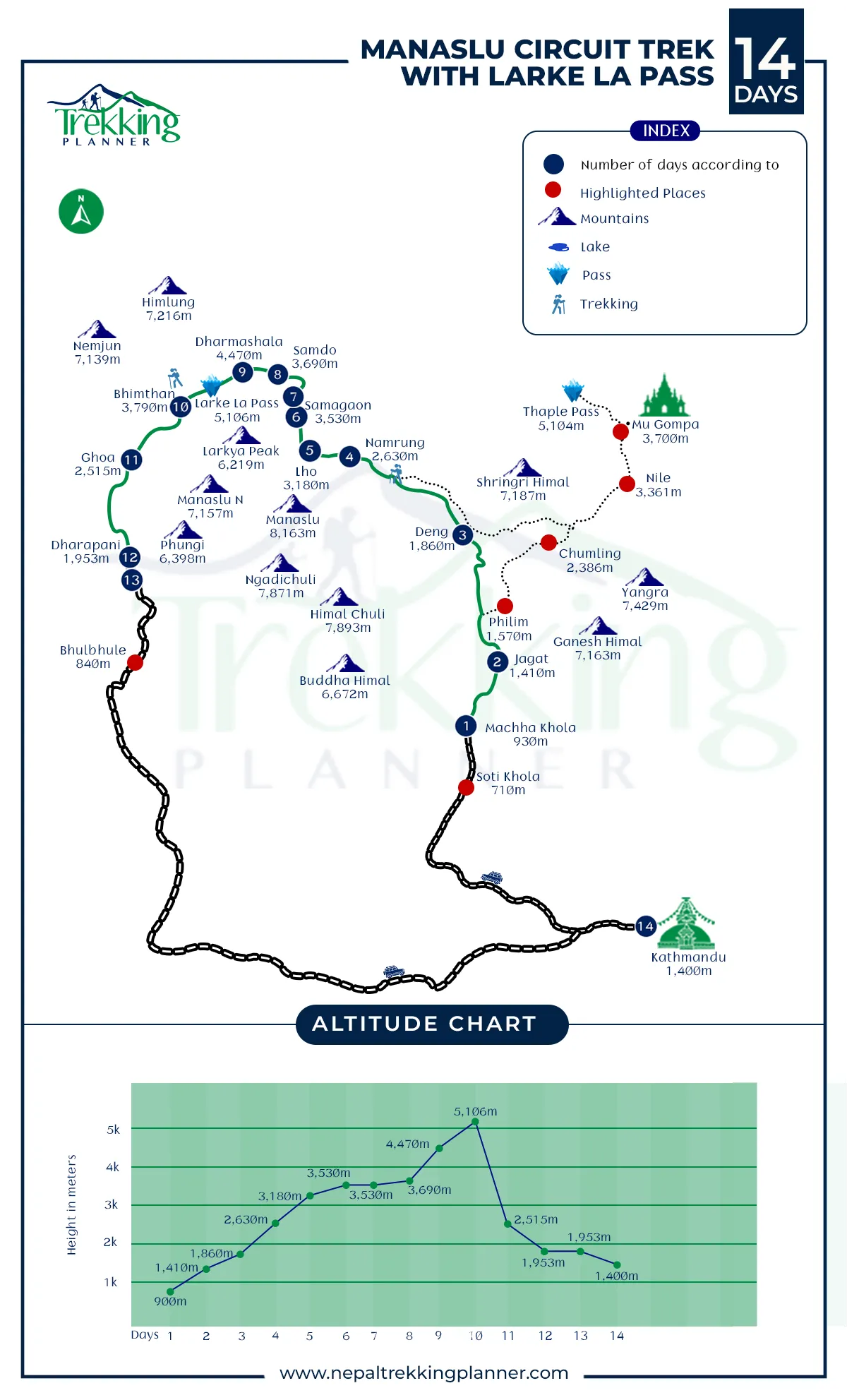
Manaslu Circuit Trek Distance and Altitude Chart
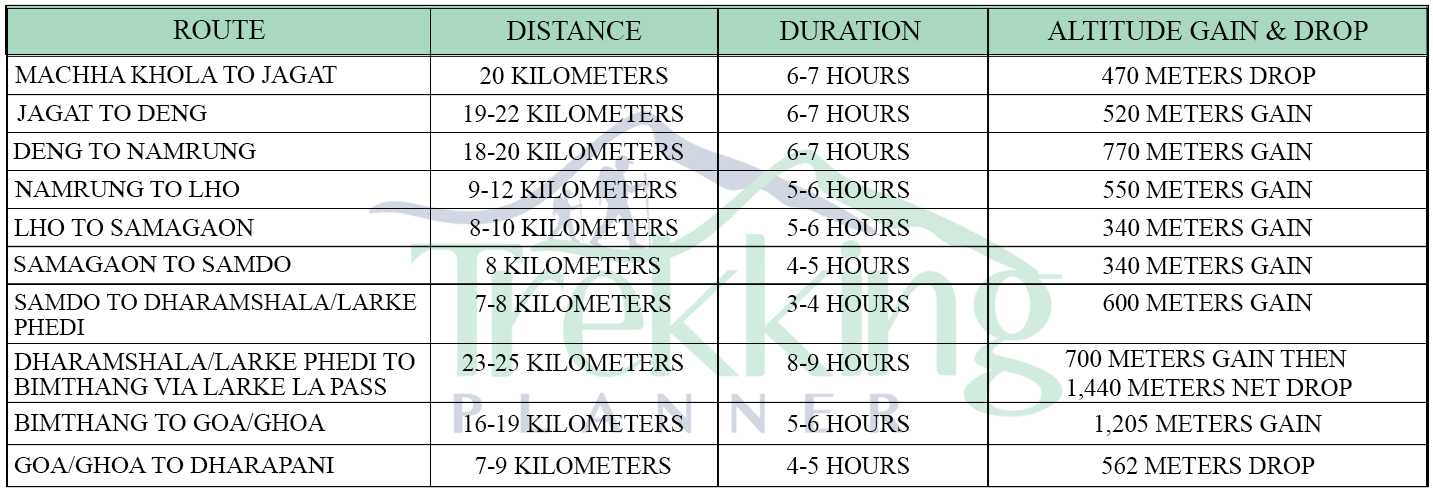
The Manaslu Circuit Trek with Larke La Pass takes place through varied landscapes and with slow, steady ascent day by day. The highest point reached during the trek is the Larke La Pass at 5,106 m/16,752 ft. Trekkers pass through various traditional settlements along the route including Jagat, Deng,Namrung, Lho, Samagaun, Samdo, Dharamshala and others. Here’s a breakdown of the trekking routes, distance, duration and altitude gain/drop each day during the trek:
Manaslu Circuit Trek Permits
The Manaslu Circuit Trekking with Larke La Pass passes through the restricted region of the Manaslu Conservation Area and the protected region of the Annapurna Conservation Area. To complete the trek, trekkers require distinct permits, including the Manaslu Restricted Area Permit (RAP), Manaslu Conservation Area Permit (MCAP), Annapurna Conservation Area Permit (ACAP), and the Trekkers’ Information Management System (TIMS) card. These permits are checked at various checkpoints throughout the Manaslu Circuit Trekking route. Here are the details:
Manaslu Restricted Area Permit (RAP)
This is a mandatory permit for the Manaslu Circuit Trekking with Larke La Pass since the trek passes through a designated restricted area. This permit is issued by the Department of Immigration in Kathmandu through a licensed trekking agency. RAP is checked at various checkpoints along the trekking route, including Jagat and Philim. Here’s a breakdown of the permit cost required to get the Manaslu Restricted Area Permit (RAP):
|
Nationality
|
September to November
|
December to August
|
|
Foreigners
|
For the initial 7 days: USD 100 + USD 15 for each additional day
|
For the initial 7 days: USD 75 + USD 10 for each additional day
|
|
SAARC countries
|
Same as Foreigners
|
Same as Foreigners
|
|
Nepali
|
free
|
free
|
The Manaslu Conservation Area Permit is another mandatory permit required for the Manaslu Circuit Trekking with the Larkya La Pass. The Manaslu Conservation Area is a designated protected region due to its rich biodiversity and unique cultural heritage. So, trekkers visiting the region must obtain the Manaslu Conservation Area Permit. The MCAP is checked at various checkpoints along the Manaslu Circuit Trekking route, including Jagat, Philim, Samagaun, Samdo, and Dharapani. Here’s a breakdown of the permit cost required to obtain the Manaslu Conservation Area Permit (MCAP):
|
Nationality
|
Cost
|
|
Foreigners
|
NPR 3000 (approx USD 20) per person
|
|
SAARC countries
|
NPR 1000 (approx USD 7) per person
|
|
Nepali
|
NPR 100 per person
|
|
Children under the age of 10
|
Free
|
The Manaslu Circuit trekking route enters the Annapurna Conservation Area after crossing the Larke La Pass. Hence, obtaining the Annapurna Conservation Area Permit (ACAP) is also mandatorily required to complete the trek. The Annapurna Conservation Area is the largest dedicated protected region in Nepal, established to protect the diverse landscapes, biodiversity, and cultural heritage of the Annapurna region. The ACAP permit is primarily checked at checkpoints in Dharapani and Bhimthang when entering the Annapurna region. Here’s a breakdown of the cost required to obtain the ACAP permit:
|
Nationality
|
Cost
|
|
Foreigners
|
NPR 3000 (approx USD 20) per person
|
|
SAARC countries
|
NPR 1000 (approx USD 7) per person
|
|
Nepali
|
NPR 100 per person
|
|
Children under the age of 10
|
Free
|
A Trekkers’ Information Management System (TIMS) card is also required to undertake the Manaslu Circuit Trek with Larke La Pass. Under the current regulations of the relevant authority (i.e., the Nepal Tourism Board), the Manaslu Circuit trek is also listed among the trekking routes where trekkers are required to be accompanied by a licensed trekking guide and to hold a TIMS card. Here’s the permit cost breakdown:
|
Category
|
Price
|
|
Solo trekkers from SAARC nations
|
NPR 600 (approx USD 4)
|
|
Group from SAARC nations
|
NPR 300 (approx USD 2) per person
|
|
Solo Foreign Trekkers
|
NPR 2000 (approx USD 13)
|
|
Group from foreign nations
|
NPR 1000 (approx USD 7) per person
|
Note: Trekking Planner Nepal Pvt. Ltd. assists trekkers with all necessary permit arrangements and paperwork for the Manaslu Circuit Trekking with Larke La Pass, preventing unnecessary hassle.
Best Time for Manaslu Circuit Trekking?
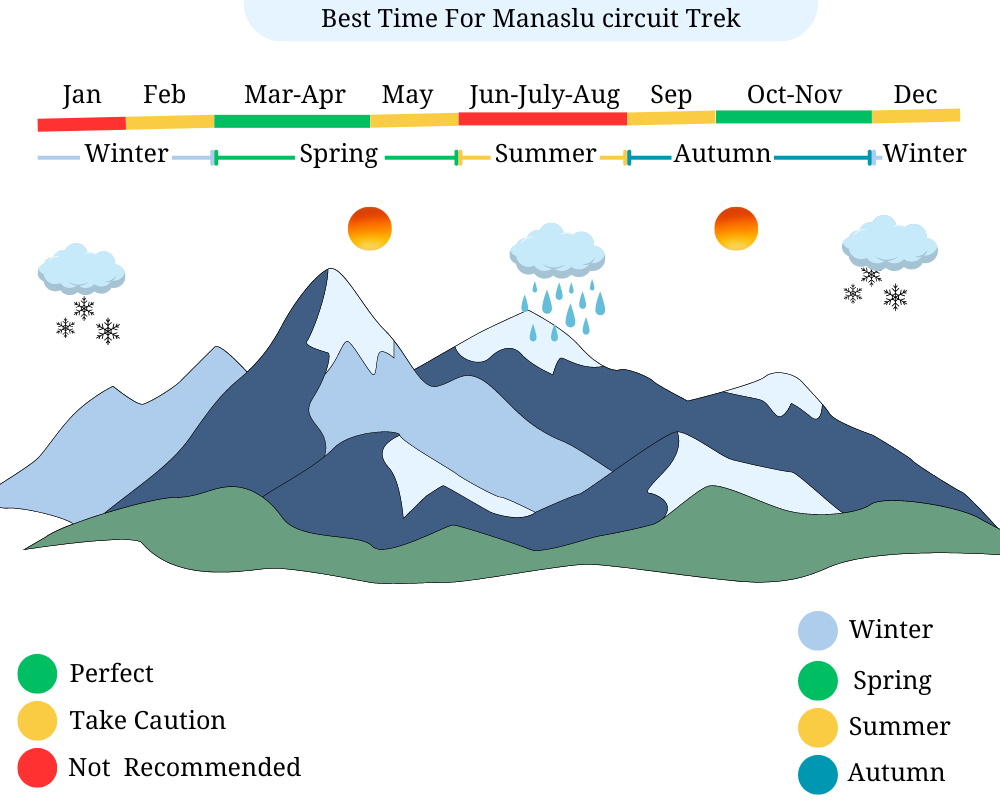
Normally, the autumn and spring seasons are considered the best time to trek in Nepal. The Manaslu Short Circuit Trek is better done from September to November and March to May. During these months, the weather is usually calm, and the skies are beautiful, providing spectacular vistas of the Himalayan peaks. The weather is pleasant during the day and chilly at night. Still, it is frequently dry and sunny, allowing for ideal hiking conditions.
The sky is bright, and the vistas are spectacular from September to November. Still, the trail is comparatively busy due to a large number of trekkers visiting during this period. The temperatures are moderate in the morning and chilly in the evening. Still, the days are pleasant and suitable for trekking. In contrast, the second-best season is March to May, when rhododendrons and wildflowers blossom along the route.
Spring (March to May): This is one of the best times to hike in Nepal. The weather is pleasant, with a clear sky and temperatures ranging from 10 to 25 degrees Celsius (50 to 77 degrees Fahrenheit) during the day. Temperatures in the evenings can drop to around 5°C (41°F).
Summer (June to August): This is monsoon season in Nepal, and trekking can be difficult due to heavy rain and muddy paths. Throughout the day, temperatures may reach up to 25°C (77°F), although the humidity can make it feel much warmer. Temperatures at night often range between 10-15°C (50-59°F).
Autumn (September to November): Nepal's autumn is a peak season for trekking. The skies are bright and dry, with warm days and cold evenings. Daytime temperatures range from 10 to 20 degrees Celsius (50 to 68 degrees Fahrenheit), with overnight temperatures plunging to roughly 0 degrees Celsius (32 degrees Fahrenheit) in higher elevations.
Winter (December to February): This is Nepal's winter season, and temperatures may be quite cold, especially at higher elevations. Daytime temperatures range from 5 to 15 degrees Celsius (41 to 59 degrees Fahrenheit), with overnight temperatures falling below freezing. The paths can be slippery and snowy, making walking more difficult.
When trekking in Nepal, it is important to be prepared for varying weather conditions and to pack appropriate clothing and equipment for the season you plan to visit. Trekking with Nepal Trekking Planner: Nepal offers the advantage of checking the weather forecast before beginning your walk and being prepared for unexpected conditions.
Manaslu Circuit Trek Difficulty
The Manaslu Circuit Trek with Larke La Pass is considered challenging for several reasons. The trek involves long, continuous walking for 5-8 hours per day, on average, over multiple days. Also, the trek traverses some of the most remote and rugged Himalayan trails in Nepal, with steep ascents and descents through high-altitude landscapes.
Altitude is the major factor that makes the Manaslu Circuit Trek challenging. Trekkers gradually ascend through lower valleys, continuing through some high-altitude settlements, including Samagaun, Samdo, and Dharamshala, before ultimately crossing the Larke La Pass at 5,106 m/16,752 ft, which is considered the most challenging section. At these high altitudes, the atmosphere contains significantly less oxygen than at sea level. Hence, physical activities like walking become challenging.
The region's remoteness can also make the trek challenging for some trekkers. The Manaslu Circuit is one of the least-explored trekking trails in Nepal. The facilities and infrastructure are absolutely not at the same level as trekkers are used to in urban areas. Hence, trekkers must be mentally prepared for the most basic facilities and amenities.
Despite being a challenging trek, the Manaslu Circuit Trek with Larke La Pass does not require any advanced technical mountaineering or climbing skills. Trekkers with a good level of physical fitness, proper acclimatization, mental determination, a well-designed itinerary, and guidance from experienced guides can successfully conquer this challenging trek. Although challenging, completing the Manaslu Circuit Trek with Larke La Pass is absolutely worth it.
Can Beginners Do the Manaslu Circuit Trek?
The Short Manaslu Circuit Trek is a challenging trip that requires a high level of physical fitness and sometimes prior trekking experience. The journey consists of many days of trekking over hilly, rocky terrain and crossing a high-altitude pass. As a result, it may not be appropriate for everyone.
If you are in good physical condition, have trekked at high altitudes before, and love a tough adventure, the Manaslu Trek may be a wonderful option for you. It is also important to remember that the trek takes you through some rural areas with limited facilities, so you should be comfortable with basic amenities and be prepared to deal with some pain.
- Fitness Level: Manaslu Short Circuit, combined with the Larke Pass Trek, is challenging and requires many hours of trekking over steep, rocky terrain. To complete the trek in 14 days, you need to be in good shape, including cardiovascular endurance and strength training. You should be able to walk 6-8 hours each day and be at ease hiking at high elevations. Trekking Planner Nepal recommends that you do some physical exercise before embarking on the trek. You are also advised to hike for hours daily to keep yourself healthy.
- Altitude sickness: One of the most serious concerns in high-altitude trekking. You can see the symptoms such as mild headaches and nausea, loss of appetite, heat stroke, dizziness, and vomiting, which can also cause serious disorders such as high altitude pulmonary edema (HAPE) and high altitude cerebral edema (HACE). Take enough time to acclimatize by gradually rising to higher elevations and allowing your body to adjust to lower oxygen levels. Altitude sickness can be increased by rushing the journey and skipping rest days.
- Trekking Experience: The Manaslu Short Circuit Trek is a remote and challenging trek that requires prior trekking experience. You should be familiar with trekking equipment, be able to handle rough terrain, and be ready to deal with changing weather conditions. If you're new to trekking, start with a shorter and less difficult trek to gain experience.
- Time Constraints: If you have only 14 days for the journey, finishing it within that time may be your only option. You should always keep in mind, however, that rushing the trek might limit enjoyment while increasing the risk of altitude sickness. You are always requested to allow additional time for the rekt if possible to achieve appropriate acclimatization and make the most of the experience.
In summary, it is feasible to do the Manaslu Circuit Trek with the Larke Pass in 14 Days. Still, you must consider your fitness level, previous trekking experience, and the danger of altitude sickness.
Altitude Sickness During the Manaslu Circuit Trek
Trekkers are very susceptible to altitude sickness during the Manaslu Circuit Trek. Signs and symptoms of altitude sickness are commonly observed above 3,000 m/9,842 ft. The Manaslu Circuit Trekking with Larke La Pass easily takes trekkers above that confined altitude, with Larke La Pass being the highest point on the trek at 5,106 m/16,752 ft. At these high altitudes, the atmospheric air contains relatively less oxygen than at sea level. Hence, the chances of altitude sickness for trekkers are quite high.
In lower elevations, including Soti Khola, Machha Khola, Jagat, etc. Trekkers will be quite comfortable with walking, and the risk of altitude sickness is close to zero. As trekkers ascend towards high-altitude settlements, including Samagaon (3,530 m/11,581 ft), Samdo (3,875 m/12,713 ft), all the way up to Larke La Pass, the chances of Altitude Sickness significantly increase.
However, it is not possible to give an exact figure for the chances of sickness. Any trekker, regardless of their age, gender, or physical fitness level, can experience the symptoms of altitude sickness. The most common initial symptoms of Acute Mountain Sickness (AMS) include headache, nausea, loss of appetite, fatigue, and shortness of breath. Mild symptoms must be monitored properly and cannot be taken lightly.
To reduce the risk of altitude sickness, ascend gradually and follow proper acclimatization techniques. Also, if the symptoms of Acute Mountain Sickness (AMS) worsen, then immediate medical care is a must. Trekkers should have proper travel insurance in case an emergency evacuation is required. But with proper physical preparation, an acclimatization hike, hydration, and guidance from an experienced guide, trekkers can complete the Manaslu Circuit Trek with Larke La Pass while minimizing the risk of altitude sickness.
Manaslu Circuit Trek Accommodation
The Manaslu Circuit Trek with Larke La Pass is more remote than the more commercialized routes, such as the Everest Base Camp Trek or the Annapurna Circuit Trek.
The trekking route passes through some of the most distant, isolated settlements. Therefore, most of the accommodation facilities and the amenities available are pretty basic. Still, the accommodation options depend upon the altitude and remoteness of the particular location. During the start and end of the trek, trekkers will stay in comfortable, standard 3 or 4-star hotels with modern facilities in Kathmandu.
Here’s a breakdown of the accommodation options available during the Manaslu Circuit Trek with Larke La Pass:
1. Tea houses
Tea houses are the most commonly available accommodation option during the Manaslu Circuit Trek. Most tea houses are locally operated and provide essential facilities and amenities for trekkers, including basic rooms with beds, mattresses, and blankets, as well as shared bathrooms. Tea houses are mostly available in all the settlements during the Manaslu Circuit Trekking with the Larke La Pass. However, the facilities become more basic as the trek gains altitude, particularly in the settlements around Larke La Pass, such as Dharamshala (Larke Phedi). Trekkers can interact with local families and other trekkers from around the world while staying at these tea houses during the trek, gaining valuable insights.
2. Lodges
Lodges are another type of accommodation available during the Manaslu Circuit Trek. However, lodges are mostly available only in major settlements and centers along the trekking route, including Namrung, Lho, Samagaun, and Bhimthang. Lodges offer better amenities and facilities than basic Tea houses. These additional amenities may include private, comfortable rooms, better dining and bathroom facilities, etc. In higher altitudes, the options become more limited. However, even at lodges along the Manaslu Circuit trek, trekkers should expect basic amenities rather than the luxurious ones found at lodges on more commercialized trekking routes.
Food During the Manaslu Circuit Trek
Food is the most basic and important amenity during any trekking adventure. The Manaslu Circuit Trekking with Larke La Pass involves trekking 5 to 8 hours a day for multiple days through challenging high-altitude landscapes and trails. Therefore, trekkers burn a significant amount of calories each day during the trek. So, consuming nutritious food in the right amounts and meeting nutritional requirements are very important for trekkers to complete the Manaslu Circuit Trek with Larke La Pass. The food options can vary from one location to another (especially as trekkers ascend to higher elevations). Still, trekkers can generally find a mix of traditional Nepali and popular international dishes throughout the journey. Here is a summary of a wide variety of food and beverages available during the Manaslu Circuit Trek with Larke La Pass:
- Breakfast: Breakfast Set, Tibetan Bread, Porridge, Toasts, Soup, Egg variety, Potato variety, Pancakes, Cereals, Paratha, Sausage, Fruits, and others.
- Lunch: Chowmein, Noodles, Thukpa, Mo: Mo, Thentuk, Potato Dishes, Rice and Curry, Dal Bhat, Fried Rice, Pasta, Pizza, Sherpa Stew, Chicken item, Buff items, Papad, Popcorn, and others.
- Dinner: Dal Bhat (rice with lentil soup), Potato items, Momo, Thukpa, Curries, Soups, Bread, Chapatti, Fried rice, Pasta, Egg items, Pizza, and others
- Beverages: Tibetan Tea, Milk Tea, Mint Tea, Lemon Tea, Lemon with ginger and honey, Americano, Cappuccino, Coca-Cola, Fanta, Sprite, Mountain Dew, Canned Juice, Energy drinks, alcoholic drinks, and others.
Toilet and Washing Facilities During the Manaslu Circuit Trekking
The Manaslu Circuit Trek is considered one of the most remote trekking routes in Nepal compared to the more commercialized routes. The infrastructure in the Manaslu region, in every aspect, cannot be compared to that of major cities. The toilet and washing facilities are not an exception. Trekkers have to prepare mentally for the lack of basic toilets and washing facilities throughout the trek.
The toilet and washing facilities still depend on the location's altitude and remoteness during the Manaslu Circuit Trekking with Larke La Pass. In the early phases of the trek and at lower altitudes, including Machha Khola, Jagat, Deng, Namrung, Lho, etc., the toilet facilities are shared and basic. Still, some accommodation facilities might still provide western-style flush toilets and attached, private bathrooms in these settlements.
As the trek progresses towards high-altitude and remote settlements, including Samagaun, Samdo, and Dharamshala, trekkers should not expect anything more than the most basic facilities. Most of the accommodation facilities offer traditional squat toilets. Hot showers or washing facilities might also be limited or even unavailable at these locations. Trekkers should prepare for simple facilities and not expect the same level of comfort as in major cities or even lower-altitude settlements along the trek.
As mentioned above, the Manaslu Circuit Trekking with Larke La Pass happens through some of the most remote settlements, where transporting and shipping basic resources is extremely difficult and expensive. Hence, trekkers may need to pay for certain facilities and amenities, such as hot water, hot showers, or even running water, at higher altitudes. These costs can range from $3 to $6. These costs help cover the cost of heating/ transporting water and other facilities in the remote settlements along the Manaslu Circuit trekking route.
Trekkers are also highly advised to carry their own tissues/toilet paper along with other personal hygiene products. The toilet, washing, and shower facilities cannot always be relied on through the remote trails of the Manaslu Circuit. Hence, personal care and hygiene items such as wet wipes, hand sanitizers, soap, toothbrush, toothpaste, and a personal towel can come in very handy during the trek.
Trekking Planner Nepal Pvt. Ltd. recommends that trekkers prepare for the most basic facilities and amenities during the Manaslu Circuit Trekking and adjust their expectations accordingly. However, with proper preparation and a small personal hygiene kit, trekkers of different ages and experience levels can comfortably manage the toilets, bathrooms, and washing facilities as needed throughout their Manaslu Circuit Trekking journey with the Larke La Pass.
Internet, Wi-Fi and Mobile Network on the Manaslu Circuit Trek
The Internet and Communication facilities are available in many sections & settlements during the Manaslu Circuit Trekking with Larke La Pass. However, the connectivity, speed, and reliability of the internet, as well as the intensity of mobile networks, can vary significantly with a location's remoteness and altitude. In lower-altitude settlements, including Machha Khola, Jagat, Namrung, Lho, and Samagaun, internet and communication services are generally reliable. But as trekkers ascend towards higher-altitude settlements, including Samdo and Dharamshala, all the way up to Larke La Pass, the facilities are limited, unreliable, or even unavailable.
Trekking Planner Nepal Pvt. Ltd. provides its trekkers with free Nepalese SIM cards (NCELL). Still, additional charges are generally applied for data packages. Trekkers can use the SIM card for general calls and messaging, and to access mobile internet in areas where the network is available. Mobile internet or mobile data is generally good and reliable in the lower sections of the trek. However, mobile data is unreliable or even unavailable, especially at high altitudes and remote sections during the Manaslu Circuit Trekking with Larke La Pass.
Wi-Fi is available in many accommodation facilities during the Manaslu Circuit Trekking route. Having said that, Wi-Fi is mostly available in the lower and middle sections of the trek, and additional charges may apply. The cost can range from USD 2 to USD 10 per device. Wi-Fi is sufficient for messaging, sending photographs, checking weather conditions, etc. As the trek progresses and trekkers reach high-altitude sections, Wi-Fi speed can be very slow, unreliable, or simply unavailable.
Phone and Gadget Charging During the Manaslu Circuit Trek
Phone and gadget charging is one of the major amenities that trekkers doing the Manaslu Circuit Trek with Larke La Pass are concerned about. Trekkers need to charge their electronic devices, including mobile phones, cameras, smartwatches, and power banks. These devices are essential for trekkers to connect with their loved ones back home, capture memorable moments during the trek, or even navigate routes.
In the lower-altitude settlements, including Machha Khola, Jagat, Namrung, Lho, etc. Electricity supply is generally available at all times; hence, the charging facilities are more reliable. As the trek progresses towards the higher and more remote settlements such as Samdo and Dharamshala, charging facilities become more limited, and electricity may not always be available. Also, charging facilities are mostly situated in common dining areas with additional charges ranging from USD 2 to USD 8 per hour or per device.
Also, trekkers are advised to carry a universal travel adaptor for convenience while trekking in remote areas of Nepal. For budget travelers who do not wish to pay for charging, carry power banks with a capacity of about 20,000 mAh. Further, to reduce battery usage, use your cellphones in battery-saving mode, turn off unnecessary applications, and reduce brightness.
Culture and Traditions of the Manaslu Region
The Manaslu Area in Nepal is home to a broad range of ethnic tribes, each with its own distinct culture and customs. The following are some of the region's major cultural aspects:
- Ethnic Groups: Many ethnic groups live in the Manaslu region, including the Gurungs, Tamangs, and Tibetans. Each community has its language, clothing, and traditions.
- Religion: Tibetan Buddhism is practiced by the majority of the people in the area. Throughout the walking track, you will encounter several Buddhist prayer flags, chortens (Buddhist shrines), and mani stones (stones engraved with Buddhist prayers).
- Festivals: Throughout the year, locals in the Manaslu area celebrate a variety of festivals, such as Tibetan New Year (Losar), which typically falls in February or March.
- Cuisine: The local cuisine of this region is influenced by Tibetan and Nepalese food. Momos (dumplings stuffed with meat or vegetables), thukpa (noodle soup), and dal bhat are among the region's most popular foods (rice and lentil soup).
- Clothing: The traditional dress of this region is distinct and colorful. Chubas are long gowns worn by women, while men wear long-sleeved shirts, waistcoats, and pants. These traditional garments are worn during festivals and other events.
- Architecture: The architecture of this area is unique, with houses made of stone and wood. Houses with flat roofs are frequently ornamented with beautiful carvings and paintings.
- Music and Dance: The Manslu area has its own traditional music and dance genres. Tamangs, for example, have a dance known as Syabru, whereas Gurungs have a dance known as Ghatu.
Trekkers can obtain a better knowledge of the place and its inhabitants by respecting and embracing local culture and customs. Throughout the journey, you are encouraged to connect with people and learn about their cultures and traditions.
Travel Insurance for the Manaslu Circuit Trek
Trekking Planner Nepal strongly advises obtaining travel insurance if you plan to do the Manaslu Circuit Trek to protect yourself against unforeseen events. Manaslu is a difficult journey across isolated, mountainous terrain; therefore, sufficient insurance coverage is essential.
When acquiring travel insurance for the trek, make sure that it covers the following:
- This should cover the cost of any medical care or evacuation if you become ill or injured while trekking.
- The insurance covers the cost of your vacation if you have to cancel or stop it due to unforeseen circumstances such as illness or an accident.
- The insurance should cover any lost or delayed luggage during your journey.
- This should cover any damages or injuries you may cause to others while on the expedition.
- Because the trek is considered an adventure sport, be sure your policy covers this sort of activity.
When choosing a travel insurance policy, carefully read the fine print to ensure you understand the coverage and any limitations. It's also a good idea to check around for the greatest coverage and budget from several insurance companies.
Manaslu Circuit Trek Preparation and Training
- The Manaslu Circuit Trek is a challenging yet rewarding trek that requires careful planning and physical fitness. Here is some preparation advice for the trek:
- Build Your Endurance: The trek requires multiple days of trekking for several hours each day, normally up and down the hill. Trekking Planner Nepal always recommends starting by walking or trekking for many hours each day for several months before your expedition.
- Strengthen Your Legs: To complete the Larke Pass and Manaslu Circuit, you will need strong leg muscles. To build your leg muscles, incorporate squats, lunges, and calf raises into your training program. This develops your strength level and later helps you during the trek.
- Cardiovascular Training: Trekking at higher altitudes requires cardiovascular endurance. Running, cycling, and swimming are all good ways to enhance your cardiovascular fitness.
- Acclimatization: Altitude sickness is a possibility during the journey. To prepare for the altitude, consider climbing several minor peaks or hills in your neighborhood or spending a few days at high altitudes before the hike.
- Appropriate Gear and Equipment: Invest in high-quality trekking equipment, such as hiking boots, warm clothes, and a dependable backpack. Before the trek, familiarize yourself with the equipment. Trekking Planner Nepal is here to provide you with high-quality gear and equipment if you require them.
- Hydration: Keeping yourself hydrated is important during the trek. Trekking Planner Nepal always recommends carrying a water bottle or hydration kit and drinking plenty of water before and throughout the trip.
- Mental Preparation: This is the most important part of the trek. You need to mentally prepare yourself by setting reasonable objectives, visualizing success, and staying optimistic.
- Consult with a medical professional: Before beginning the journey, it is best to speak with one if you have any medical conditions or concerns.
Tips for Female Trekkers
- Prepare for irregular or unexpected periods at high altitudes.
- Bring extra menstrual cups, tampons, or pads along with disposal bags and intimate wipes.
- Carry period supplies in your daypack instead of using the porter bag.
- For better management and less waste, consider using a menstrual cup.
- Although not mandatory, for usage on the route and at night, bring a female urination device (such as Shewee).
- Always keep your own hand sanitizer, wet wipes, and toilet paper on hand.
- For quicker and cleaner trail restroom stops, use a pee towel.
- For brief showers, bring deodorant wipes, dry shampoo, body wipes, and facial wipes.
- Bring non-cotton underpants and sports bras that dry quickly.
- As soon as you arrive, change into dry lodge attire.
- Apply moisturizer, SPF lip balm, and high-SPF sunscreen every day.
- Hire a trustworthy guide, especially if you're traveling alone (a female guide option is available).
- Train with cardio and pack-weighted walks weeks in advance.
- Discuss altitude medication with your doctor.
- Stay well hydrated and follow the standard acclimatization itinerary.
Be Prepared for Manaslu Region Trekking
Manaslu Region | Guide to Manaslu Circuit Trek | Manaslu Circuit Trek Preparation | Best Time for Manaslu Trek | Why Manaslu is a Restricted Area | Reason to Trek to Manaslu
Want Different Experience? Check our Manaslu Packages Variation
Manaslu Tsum Valley Trek | Tsum Valley Manasu Short Trek | Tsum Valley Trekking | Manaslu Circuit Short Trek | Lower Manaslu Trekking
Responsible Trek around Manaslu
Responsible Trekking is an ethical approach to trekking adopted by trekkers to protect the natural and cultural heritage, as well as the fragile environmental ecosystem, of the Manaslu and Annapurna regions during the Manaslu Circuit Trekking with Larke La Pass. The Manaslu Circuit Trek passes through designated protected areas, and it is important to adopt responsible trekking practices on these sensitive Himalayan trails. By following the responsible trekking guidelines, trekkers can contribute to preserving and promoting these trails for future generations:
What to do during the Manaslu Trek?
- Respect local traditions and customs (especially when visiting religious sites such as monasteries, chortens, and prayer walls) by dressing modestly and asking permission before photographing.
- Walk clockwise around stupas, mani walls, and prayer wheels as a sign of respect and understanding towards Buddhist culture.
- Carry a reusable water bottle to reduce plastic waste.
- Dispose of waste responsibly or carry it with you until you find a designated waste disposal center.
- Stay on the marked trekking trails to protect the fragile vegetation and prevent soil or vegetation erosion.
- Support local communities by staying in local tea houses/lodges and purchasing locally produced food products and handicrafts whenever possible.
What not to do during the Manaslu Trek?
- Do not litter or leave any waste along the trail during the trek, including plastic food wrappers, plastic bottles, or cigarette butts, etc.
- Do not disturb the wildlife, damage plants or natural vegetation, or get involved in any sort of activities that hamper the natural ecosystem in the Manaslu & Annapurna Conservation Areas.
- Avoid disturbing or making excessive noise, especially in and around monasteries, local settlements, and wildlife habitats.
- Avoid wearing excessively revealing clothes, especially in and around religious and cultural sites. It may not entertain the religious and cultural sentiments of the local people.
- Never leave the marked trail or attempt to walk through difficult sections in unsafe conditions without your guide's advice.
- Avoid using single-use plastics whenever possible and help keep the Himalayas clean for future generations.
Why Choose Trekking Planner Nepal for the Manaslu Circuit Trek?
- With years of experience and enhancements to our operations, we have a proven track record in trekking operations.
- Our trekking packages are operated in small groups; hence, trekkers get personalized care and service at all times.
- Our team of professional, licensed guides possesses remarkable trekking knowledge, providing trekkers with excellent guidance, safety support, and personalized care.
- We arrange delicious, nutritious meals throughout our treks to meet trekkers' nutritional needs and provide the best-quality gear and equipment.
- Our on-field team, along with local guidance, assists with every minute activity and planning during the trek.
- At every stage of our trek, from itinerary planning to on-field protocols and emergency support, we prioritize your safety and comfort above all else.
- Our representatives and consultants are there at your service 24/7. You get quick response and practical assistance from our team regardless of the complexity of the situation.
- We run our tours across a wide range of destinations, offering customized or personalized itineraries for our clients.
- We genuinely and ethically follow responsible, sustainable trekking practices and protocols to preserve natural trails and cultural heritage for future generations in the destinations where we run our tours.
- Returning travelers receive a special 10% discount along with their family members (spouse and children).
- We give it our all to accommodate any last-minute bookings and manage travel arrangements and logistics for our clients' desired dates.
- Our team always remains on standby on the ground to assist you in any unforeseen circumstances.
- Our trek & tour packages can accommodate a range of budgets. From affordable group departures to private & customized tours, we can handle it all.
Conclusion
The 14-day Manaslu Circuit Trekking with Larke La Pass is an unforgettable trekking journey through impressive landscapes and remote trails of the Manaslu region. The combination of high-altitude trails, spectacular scenery, cultural heritage, and the region's remoteness is the signature of this trek. Passing through mesmerizing natural beauty, Tibetan-influenced settlements including Namrung, Lho, Samagaun, Samdo, etc, and crossing the Larke La Pass at 5,106 m/16,752 ft, every day of this journey offers a remarkable experience for trekkers.
If you are ready and willing to explore the exquisite beauty of the Manaslu & Annapurna regions along with the iconic Larke La Pass, join us on the Manaslu Circuit Trekking with Larke La Pass. Contact Trekking Planner Nepal Pvt. Ltd. today and start planning your journey.




 General